
UGC advertising ROI, influencer marketing ROI, UGC creator cost India, influencer advertising rates 2026, Meta Partnership Ads
UGC Ads vs Influencer Ads: Which Is Better for ROI? 2026 Cost, Performance & Strategy Guide
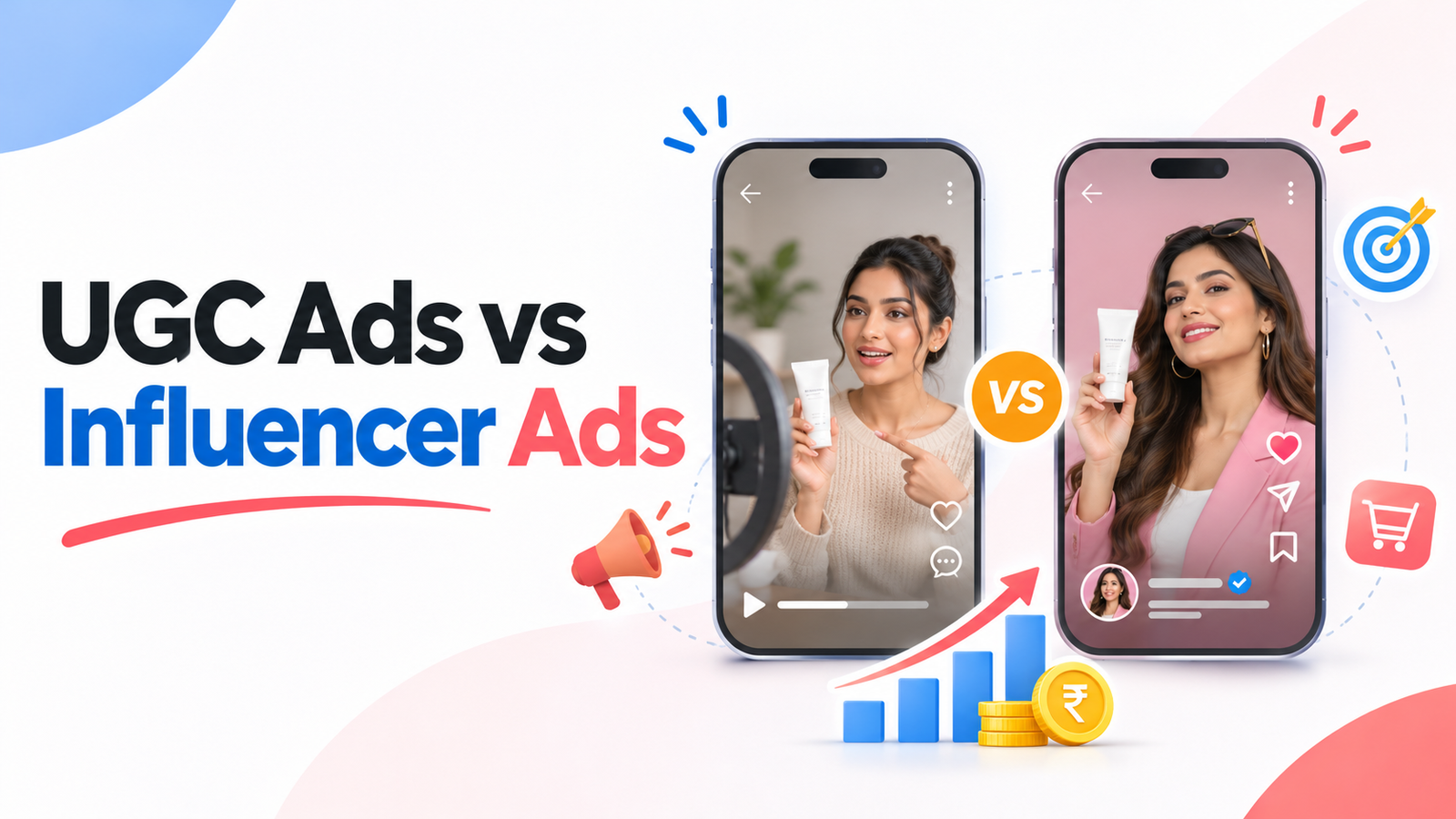
An Instagram Reel featuring someone genuinely demonstrating a product can influence purchasing decisions more effectively than an expensive advertisement that communicates very little. But does that mean brands should invest in user-generated content (UGC) instead of influencer marketing?
Not necessarily.
The advertising industry increasingly uses creator content in two commercially different ways: commissioning authentic-looking videos for brands to distribute through paid advertisements, and partnering with influencers who introduce products to their established audiences.
Both can generate awareness, engagement and sales. However, their cost structures, distribution models and return on investment (ROI) can differ considerably.
According to the Interactive Advertising Bureau's Creator Economy Report, US creator advertising expenditure was projected to reach $37 billion in 2025, with a further projection of $44 billion in 2026.
India is experiencing a similar expansion. Kofluence's Decoding Influence 2026 report puts India's influencer marketing expenditure at approximately ₹3,500 crore.
Meanwhile, research published by Agentio in August 2026 found that Meta Partnership Ads using creator identities generated 19% higher click-through rates, 10% higher conversion rates and 5% lower cost per acquisition than licensed UGC running from brand accounts within its analysed sample.
That finding changes how marketers should approach the debate.
The question is no longer simply UGC Ads versus Influencer Ads. It is which combination of content, credibility, distribution and media investment produces the strongest commercial return.
This guide compares the two strategies, examines India-specific pricing benchmarks, explains advertising metrics and provides practical frameworks for measuring profitability.
1. What Are UGC Ads?
User-generated content traditionally refers to content created by actual customers or users of a product, rather than by the brand itself.
It can include customer testimonials, product demonstrations, reviews, unboxing videos and photographs.
In modern advertising, however, the term UGC Ads is frequently used to describe creator-made content produced specifically for a brand's advertising campaigns.
This distinction matters.
A genuine customer voluntarily sharing a product experience is different from a paid creator who has been commissioned to demonstrate the same product.
Both may be useful, but paid creator content should not be misleadingly presented as an unsolicited customer recommendation.
Example of a UGC-style advertisement
Consider a skincare brand selling a moisturiser.
Instead of commissioning an expensive studio commercial, the brand hires a content creator to produce a 30-second video demonstrating how the product fits into a skincare routine.
The video might include a relatable opening, the product demonstration, accurate product information and a call to action.
The brand purchases appropriate usage rights and runs the video through its Meta advertising account.
In this arrangement, the brand is primarily paying for content production and distribution rights, not necessarily access to the creator's own audience.
Types of UGC used in advertising
UGC-style advertising can include testimonials, problem-solution videos, comparison content, tutorials, product demonstrations, unboxing videos and founder-customer conversations.
The most effective format depends on the product and the decision a customer is trying to make.
2. What Are Influencer Ads?
Influencer advertising involves a commercial collaboration with someone who has an established audience and the ability to shape purchasing decisions.
A brand may pay an influencer to create and publish content through their own Instagram, YouTube or other social channels.
The advertiser benefits not only from the content but also from the influencer's audience relationship, identity and distribution.
For example, a fitness creator might introduce a nutrition product to followers who already consume their workout content.
The brand pays for the collaboration, which may include a Reel, Stories, a product demonstration, affiliate commission or additional advertising permissions.
Influencer Ads can use UGC-style content
An influencer can produce the same informal video style commonly associated with UGC.
That video can then be distributed through several methods.
| Distribution model | Who provides the audience? | Main cost |
|---|---|---|
| Licensed UGC advertisement | Brand's paid-media targeting | Production, rights, media |
| Organic influencer collaboration | Influencer's audience | Sponsorship and production |
| Influencer post with paid boosting | Influencer plus paid distribution | Creator fee, rights, media |
| Meta Partnership Ad | Paid distribution with authorised creator identity | Creator arrangement, authorisation, media |
This is the central distinction: UGC is a content approach; influencer marketing is a creator-partnership strategy.
A brand may benefit from using both.
3. UGC Ads vs Influencer Ads: Key Differences
| Parameter | UGC Ads | Influencer Ads |
|---|---|---|
| Primary value | Content that communicates effectively | Content plus established audience and identity |
| Creator follower count | Often less important | Relevant to reach and audience quality |
| Typical distribution | Brand-owned or paid channels | Creator-owned and potentially paid channels |
| Pricing | Production fee plus usage rights | Sponsorship fee plus potential extras |
| Creative control | Usually specified through the brief and contract | Shared with the influencer |
| Reach | Depends on distribution | Depends on actual audience delivery and promotion |
| Main commercial advantage | Creative testing and reuse flexibility | Audience access, endorsement and discovery |
| Main challenge | Creative quality and acquisition economics | Creator selection, pricing and attribution |
| Suitable objectives | Conversion testing, product demonstrations | Awareness, category education, social proof and sales |
Neither strategy automatically generates superior ROI.
A successful UGC advertisement can outperform an influencer partnership when it communicates a compelling offer and reaches the right audience efficiently.
An influencer collaboration may outperform UGC when the creator has a strong audience relationship and introduces a product to buyers the brand would otherwise struggle to reach.
4. Creator Advertising Statistics: What the 2026 Data Shows
The growth of creator advertising reflects a larger shift towards content built around people, expertise and social communities.
Industry statistics
| Indicator | Latest reported figure |
|---|---|
| US creator advertising spend, 2021 | $13.9 billion |
| US creator advertising spend, 2024 | $29.5 billion |
| US creator advertising spend, 2025 projection | $37 billion |
| US creator advertising spend, 2026 forecast | $44 billion |
| India influencer marketing expenditure, 2026 estimate | ₹3,500 crore |
| Brands in Kofluence research that have run partnership ads | 76.6% |
| Respondents agreeing long-term partnerships deliver better ROI | 62.1% |
| Creator advertising buyers identifying online sales as a goal | 32% |
Sources: IAB Creator Economy Research and Kofluence Decoding Influence 2026.
The US advertising totals and Indian market estimate come from different methodologies and should not be directly compared as equivalent datasets.
The 62.1% figure reflects surveyed respondents' assessment of long-term partnerships, not objectively measured ROI improvements across all influencer campaigns.
A shift from impressions to commercial outcomes
IAB reported that 40% of surveyed creator-advertising buyers ranked overall ROI as their top key performance indicator.
The implication is that creators are no longer evaluated solely through followers, likes or brand visibility.
Advertisers increasingly want to understand whether creator campaigns generate attributable revenue, qualified customers and commercially meaningful results.
For brands, this makes proper measurement and contribution economics essential.
5. UGC Advertising Cost in India: 2026 Benchmarks
One reason UGC advertising appeals to smaller D2C brands is its relatively accessible creative-production cost.
A 2026 Indian UGC marketplace guide reports typical rates of approximately ₹2,500–₹5,000 per test video, excluding paid advertising rights and media spend.
Indicative UGC production budgets
| Requirement | Indicative cost |
|---|---|
| One basic UGC-style video | ₹2,500–₹5,000 |
| Three to five test videos | ₹7,500–₹25,000 |
| Eight to twelve monthly videos | ₹24,000–₹72,000 |
| More involved product-launch videos | ₹5,000–₹12,000 each |
| Additional paid usage rights | Often 30%–100% of production fee |
Source: UGC Content — India Campaign Budget Guide, September 2026.
These are supplier-published planning benchmarks, not a verified national average of completed transactions.
Understanding paid usage rights
Suppose a UGC creator charges ₹4,000 to produce a video.
If paid advertising rights are priced at an additional 50%, the brand would pay:
₹4,000 + ₹2,000 = ₹6,000
That does not include the advertising budget.
The agreement should specify the duration and platforms on which the brand may use the video.
Brands should also confirm whether editing, cropping, subtitle changes, new hooks, reposting and additional campaign usage are permitted.
Without a clear agreement, an inexpensive video can become costly to reuse.
6. Influencer Advertising Cost in India: Why Rate Cards Disagree
Influencer pricing is more complicated because advertisers are purchasing both creative work and some form of audience access.
Fees depend on audience quality, content category, expected reach, engagement history, geography, exclusivity and usage rights.
Different 2026 creator-pricing studies report dramatically different figures.
What actual marketplace datasets show
| Research source | Creator tier | Median listed price per Reel |
|---|---|---|
| Hypee, November 2026 | Nano: 1K–10K followers | ₹1,500 |
| Hypee, November 2026 | Micro: 10K–50K followers | ₹4,000 |
| Digital Berries, October 2026 | Micro: 10K–100K followers | ₹40,000 |
| Digital Berries, October 2026 | Mid-tier: 100K–500K followers | ₹70,000 |
| Digital Berries, October 2026 | Macro: 500K–1M followers | ₹1,00,000 |
| Digital Berries, October 2026 | Mega: over 1M followers | ₹2,00,000 |
Sources: Hypee's analysis of 1,359 creator media kits and Digital Berries' 810-rate-card study.
Why is one micro-influencer median ₹4,000 and another ₹40,000?
The datasets are not directly comparable.
They use different creator networks, sampling approaches and follower-count categories.
The Hypee study contains a large number of smaller creators, while Digital Berries analyses rate cards from its talent network.
Both measure listed asking rates, not necessarily final negotiated payments.
A follower-count-based rate card should be treated as a screening tool, not as proof of advertising value.
Before negotiating, brands should review actual post reach, relevant audience demographics, historical paid-collaboration performance and the proposed deliverables.
7. Which Performs Better? The 2026 Meta Partnership Ads Study
The most relevant performance comparison is not necessarily between different creators.
A better question is what happens when similar creator content is distributed through different advertising arrangements.
In August 2026, advertising technology company Agentio published an analysis covering:
$130 million in advertising expenditure.
Approximately 65,000 Meta Partnership Ads.
137 brands in the analysed dataset.
The study compared Meta Partnership Ads with licensed creator-generated content distributed from brand accounts.
Reported relative performance
| Performance metric | Partnership Ads vs licensed UGC |
|---|---|
| Click-through rate | 19% higher |
| Conversion rate | 10% higher |
| Cost per acquisition | 5% lower |
Source: Agentio — A Playbook to Unlock an Infinite Creative Engine, August 2026.
The research suggests that the identity associated with an advertisement can influence performance, even when the underlying creative is similar.
A familiar creator identity may provide audience context that a brand-only advertisement does not.
However, the findings are based on data published by a company operating within the creator-advertising ecosystem.
They are not a controlled industry-wide experiment proving that influencer campaigns universally outperform UGC.
Another important finding: Creative fatigue
Agentio found that winning advertisements in its dataset experienced fatigue after approximately 36 days on average.
The report also found that around one in five advertisements achieved its defined winning criteria within a purchase-optimised testing subset.
These findings reinforce the importance of refreshing advertisements and continuously testing creative ideas.
But brands should not automatically adopt Agentio's US-dollar testing thresholds for Indian campaigns with much smaller budgets.
The appropriate test size depends on conversion volume, expected acquisition costs and campaign economics.
8. How to Calculate UGC Ads ROI and Influencer Marketing ROI
The most common approach is to calculate return on advertising spend.
ROAS = Attributed Revenue ÷ Advertising Expenditure
However, the calculation can be misleading if one campaign includes creator-production fees and another does not.
A more useful comparison includes all relevant campaign costs.
Calculate the true UGC campaign cost
UGC Campaign Cost = Production + Usage Rights + Paid Media + Other Campaign Expenses
For influencer campaigns:
Influencer Campaign Cost = Creator Fees + Paid Amplification + Usage Rights + Operational Expenses
Campaign ROI can then be calculated as:
ROI = (Campaign Contribution − Campaign Cost) ÷ Campaign Cost × 100
Here, campaign contribution means the revenue remaining after product and other relevant variable costs, before deducting the marketing costs included in the calculation.
This distinction matters because ROAS measures attributed sales relative to expenditure, while contribution-based ROI provides a closer view of commercial profitability.
9. Market Creators ROI Model: A ₹1.5 Lakh Campaign Comparison
Consider an Indian D2C brand selling products with an average realised order value of ₹1,500.
Assume its pre-advertising contribution margin is 40%.
The brand evaluates two campaign strategies over a similar period.
Scenario A: UGC Videos with Paid Meta Advertising
| Cost or outcome | Illustrative figure |
|---|---|
| Six UGC videos at ₹4,000 each | ₹24,000 |
| Paid usage rights at 50% | ₹12,000 |
| Meta advertising expenditure | ₹1,20,000 |
| Total campaign investment | ₹1,56,000 |
| Assumed average CPC | ₹12 |
| Estimated paid clicks | 10,000 |
| Assumed purchase conversion rate | 3.5% |
| Attributed purchases | 350 |
| Attributed revenue | ₹5,25,000 |
| All-in ROAS | 3.37x |
| Contribution before campaign costs | ₹2,10,000 |
| Contribution after campaign costs | ₹54,000 |
Scenario B: Influencer Collaborations with Paid Boosting
| Cost or outcome | Illustrative figure |
|---|---|
| Four creator collaborations at ₹15,000 | ₹60,000 |
| Boosting expenditure | ₹80,000 |
| Product shipping and coordination | ₹10,000 |
| Total campaign investment | ₹1,50,000 |
| Assumed attributable sessions | 7,500 |
| Assumed purchase conversion rate | 4% |
| Attributed purchases | 300 |
| Attributed revenue | ₹4,50,000 |
| All-in ROAS | 3.00x |
| Contribution before campaign costs | ₹1,80,000 |
| Contribution after campaign costs | ₹30,000 |
These figures are Market Creators' original hypothetical calculations, not reported outcomes from actual client campaigns.
The model holds average order value and contribution margin constant but uses different assumed traffic and conversion outcomes.
Under these assumptions, the UGC campaign contributes ₹24,000 more after campaign costs.
However, changing the influencer campaign's delivered sessions, conversion rate or customer value could reverse that result.
This illustrates a financial decision framework, not proof that UGC produces better ROI in real campaigns.
The break-even ROAS formula
If a business retains 40% of realised sales before advertising expenses:
Break-even ROAS = 1 ÷ 0.40 = 2.5x
At 20% contribution margin, the break-even threshold increases to 5x.
At 25%, it becomes 4x.
Brands should calculate their own threshold before deciding whether either advertising strategy is profitable.
10. Which Strategy Is Better for Different Marketing Goals?
Different business objectives favour different combinations of content and distribution.
| Objective | Approach to evaluate first | Reason |
|---|---|---|
| Testing multiple video hooks | Licensed UGC | More direct control over variations |
| Reaching an established niche community | Influencer collaboration | Existing relevant audience |
| Product education and demonstration | Either | Depends on credibility and format |
| Building awareness for an unfamiliar brand | Influencers plus paid distribution | Combines introduction with amplification |
| Scaling a proven paid advertisement | Licensed UGC or Partnership Ads | Supports structured media buying |
| Regional-language product promotion | Local creators, using either model | Cultural and linguistic relevance |
| Long-term brand ambassadorship | Influencer partnership | Relationship continuity |
| Direct-response ecommerce acquisition | Controlled test of both | Contribution depends on actual results |
For D2C ecommerce brands
A sensible starting strategy may involve commissioning several product-demonstration videos and testing them through Meta advertising.
Once the strongest creative angles are identified, brands can explore creator partnerships to extend reach and credibility.
For FMCG brands
Regional influencer collaborations can be useful for building familiarity and demonstrating products within culturally relevant settings.
UGC-style paid advertising can complement these campaigns with product-specific performance testing.
For education brands
Course demonstrations, student-experience content and expert explanations can be relevant, but claims must be accurate and appropriately substantiated.
Brands should distinguish genuine independent testimonials from sponsored promotional content.
For B2B businesses
Specialist creators can introduce products to professional communities, while commissioned video explainers can support lead-generation and remarketing campaigns.
Qualified lead cost is likely to matter more than raw view counts.
For local businesses
A smaller local creator with genuinely relevant followers may be more useful than a much larger creator whose audience is geographically dispersed.
11. Why the Cheapest Creator Is Not Always the Best Investment
A creator charging ₹3,000 may appear substantially more economical than one charging ₹30,000.
But the lower fee does not prove better value.
Consider a hypothetical comparison:
| Measure | Creator A | Creator B |
|---|---|---|
| Collaboration fee | ₹5,000 | ₹20,000 |
| Verified campaign reach | 15,000 | 100,000 |
| Effective reach CPM | ₹333 | ₹200 |
| Attributed purchases | 8 | 50 |
| Cost per attributed purchase | ₹625 | ₹400 |
In this example, Creator B delivers lower cost per reached user and attributed purchase despite charging four times more.
The important variables are actual delivery, audience fit and commercial outcomes.
Follower counts should not be treated as verified reach. Likewise, platform views are not necessarily unique people.
Brands should request appropriate analytics evidence and understand what the reported metrics actually measure.
12. How to Select Influencers for Maximum ROI
Creator selection deserves more attention than follower count alone.
Start with audience relevance.
Does the creator reach people likely to be interested in the advertised category?
Next, examine the consistency and quality of content.
A creator whose normal videos focus on specialist financial education may not be appropriate for an unrelated fashion promotion.
Review past commercial collaborations where information is available.
Look at actual reach, audience geography, meaningful interactions and the creator's ability to communicate a brand's message naturally.
Also examine advertising suitability, legal claims, exclusivity arrangements and the creator's professional reliability.
For businesses operating across India's diverse regional markets, language and local relevance can be especially important.
Kofluence's 2026 research highlights the growing importance of regional and vernacular creator activity.
The objective is to find the most relevant audience relationship—not necessarily the largest account.
13. How to Create High-Converting UGC Ads
Strong UGC-style advertising requires more than an informal camera angle.
Start with a specific customer problem
The opening should address a real need, objection or situation.
For example, a footwear brand could focus on what customers should consider when selecting comfortable everyday shoes.
Demonstrate the product clearly
Show what the product does and how it is used.
Specific demonstrations are generally more useful than generic statements that a product is exceptional.
Provide credible supporting information
Where possible, demonstrate features or make claims backed by substantiated product information.
Avoid inventing testimonials, results or personal experiences.
Create multiple openings
The same product video can be tested with different hooks.
One version might focus on a problem, another on a feature, and another on a product comparison.
End with an appropriate next step
For an ecommerce brand, this might be a product-page visit.
For a B2B service, it might be a consultation request.
Measure beyond attention
Creative success should be assessed against relevant business actions rather than relying entirely on watch time or engagement.
14. The Hybrid Model: Combining UGC with Influencer Advertising
A hybrid approach can address the limitations of both standalone strategies.
A brand might initially commission five or six creator-style videos for paid advertising.
It can test several message angles, identify promising creatives and examine which content generates relevant enquiries or orders.
The brand could then collaborate with suitable influencers who create their own content around the strongest product benefits.
Where mutually agreed, the advertiser may amplify creator posts through authorised partnership advertising.
Meta's Instagram Creator Marketplace supports discovery and collaboration between brands and creators, while partnership advertising provides a way to distribute suitable creator content through paid media.
Why the hybrid approach can work
UGC production supports creative experimentation.
Influencer collaborations offer access to audience relationships.
Paid amplification allows the brand to extend distribution beyond a creator's initial organic reach.
The strategy still requires proper campaign measurement, licensing and audience selection.
There is no guarantee that combining the formats will produce more sales than a well-executed single-channel approach.
15. How to Test UGC Ads vs Influencer Ads Fairly
A fair test should avoid comparing unrelated campaigns without accounting for major differences.
Establish comparable business objectives
Both strategies should aim towards a clearly defined result, such as purchases, qualified leads or meaningful product enquiries.
Compare complete campaign costs
Include creator payments, production, usage rights, agency fees and paid media where relevant.
Use consistent revenue measurement
The same conversion definitions, refund treatment and revenue basis should apply.
Isolate important variables
Where possible, test the same licensed creator asset from a brand identity and through an authorised creator identity.
This provides a cleaner comparison than using completely different videos, audiences and offers.
Use consistent attribution settings
A creator's audience may visit the brand directly several days after seeing a campaign.
Paid-media platforms may also claim credit through different attribution windows.
These differences should be reviewed before comparing reported ROAS.
Measure incrementality
For larger campaigns, geo-based or audience holdout testing can help estimate whether advertising caused additional purchases.
For smaller campaigns, consistent tracking, post-purchase surveys and careful analysis of sales trends can provide directional evidence, although they do not prove causality.
16. Compliance and Usage Rights: Essential for Indian Advertisers
Creator advertising must comply with applicable advertising requirements.
The Advertising Standards Council of India (ASCI) states that influencer advertisements involving a material connection between a creator and an advertiser must carry an appropriate disclosure.
Material connections can include money, free products, discounts, gifts, trips and other benefits.
Disclosures must be clearly visible and understandable.
For videos without accompanying text or captions, ASCI's guidance specifies:
| Video duration | Disclosure requirement |
|---|---|
| 15 seconds or less | Visible for at least 3 seconds |
| More than 15 seconds but under 2 minutes | Visible for at least one-third of the video |
| 2 minutes or longer | Visible during sections where the promoted brand or claims are discussed |
These are the applicable provisions for the described type of video, not an exhaustive summary of every disclosure format.
Source: ASCI's official Influencer Disclosure Tool.
Contracts and intellectual property
Brands should specify who owns the final creative, what rights are being licensed, where it may be published and how long those rights remain valid.
Creators may retain rights to their work unless the contract provides otherwise.
Important contractual provisions include paid advertising permissions, territory, licence duration, permitted edits, music rights, likeness permissions, exclusivity, approvals and termination terms.
A brand should not assume that paying for an influencer Reel automatically grants unlimited rights to reuse it in advertisements.
17. A 30-Day UGC and Influencer ROI Testing Plan
Brands can use a focused pilot to gather evidence before committing to a longer-term programme.
| Period | Main activity | Output |
|---|---|---|
| Days 1–7 | Audit product economics and shortlist creators | Campaign objectives, rights and budget |
| Days 8–14 | Produce UGC and influencer assets | Approved content and tracking |
| Days 15–21 | Run defined campaigns and monitor delivery | Initial acquisition and engagement data |
| Days 22–30 | Evaluate costs, conversions and creative quality | Decision on what to retain or retest |
A 30-day pilot is useful for directional learning but may be insufficient for statistically reliable results where conversion volumes are low.
Market Creators recommends developing a performance review that includes creative effectiveness, audience relevance, acquisition costs and actual contribution after marketing.
Longer-term creator arrangements should be evaluated through repeat campaign performance, not simply one successful or unsuccessful post.
18. Frequently Asked Questions
Are UGC Ads better than influencer marketing?
Neither is universally better. UGC can provide flexible creative assets for paid advertising, while influencer marketing combines content with an established audience. Results depend on distribution, costs, audience fit and conversion performance.
How much does one UGC video cost in India?
Third-party 2026 marketplace guidance indicates approximately ₹2,500–₹5,000 for many basic test videos, with additional charges potentially applying for paid usage rights, complex production and revisions.
Are micro-influencers cheaper than UGC creators?
Not necessarily. Micro-influencer fees vary widely by audience, niche and expected delivery. UGC creators may also charge more for complex production or extensive licensing.
Can brands run influencer content as paid advertisements?
Yes, where the appropriate usage rights and platform authorisations have been obtained. Commercial posting rights and paid amplification rights should be negotiated explicitly.
What is a good influencer marketing ROI?
A useful target depends on contribution margin, customer value, acquisition cost and campaign objectives. There is no universal profitable ROAS.
Do UGC creators need a large follower base?
Not when the primary deliverable is content for the brand's own advertising channels. Portfolio quality, presentation ability, creative skills and product fit may be more relevant.
Are influencer advertisements required to disclose sponsorship in India?
Yes, where a material connection exists under applicable advertising guidelines. Disclosures should be prominent and appropriate to the media format.
Should brands use influencers or paid UGC for product launches?
Brands can test both. Influencer partnerships can introduce a product to relevant communities, while licensed UGC can support controlled advertising experiments and repeated creative testing.
19. Final Verdict: Which Delivers Better ROI?
The evidence available in 2026 does not establish a universal winner between UGC Ads and Influencer Ads.
UGC-style content can be particularly useful for businesses that need creative flexibility, controlled paid distribution and repeated testing.
Influencer marketing can create additional value when a creator has a credible relationship with an audience relevant to the advertised product.
The latest Meta advertising research also suggests that creator identity can influence performance independently of the content itself.
For brands seeking measurable results, the most effective decision is to evaluate the complete economics of each approach.
The best-performing strategy is the one that generates the highest incremental business value after accounting for creator fees, advertising costs, usage rights, product margins and operational expenses.
For many businesses, this may mean combining UGC production with selective influencer partnerships rather than choosing only one.
Plan a Creator-Led Campaign with Market Creators
Market Creators helps brands connect creator selection, content planning, campaign execution and performance measurement around clear business objectives.
From evaluating relevant creators and coordinating usage rights to planning paid amplification, the objective is to build campaigns that work for both the audience and the business.
Explore our Influencer Marketing Services, Performance Marketing and Digital Marketing capabilities.
For campaign planning and creator collaborations, contact Market Creators.