
ChatGPT advertising cost, ChatGPT Ads India, Google Ads vs AI advertising, ChatGPT Ads ROI, ChatGPT Ads CPC
ChatGPT Ads vs Google Ads: Where Should Brands Spend in 2027? Costs, ROI, Targ
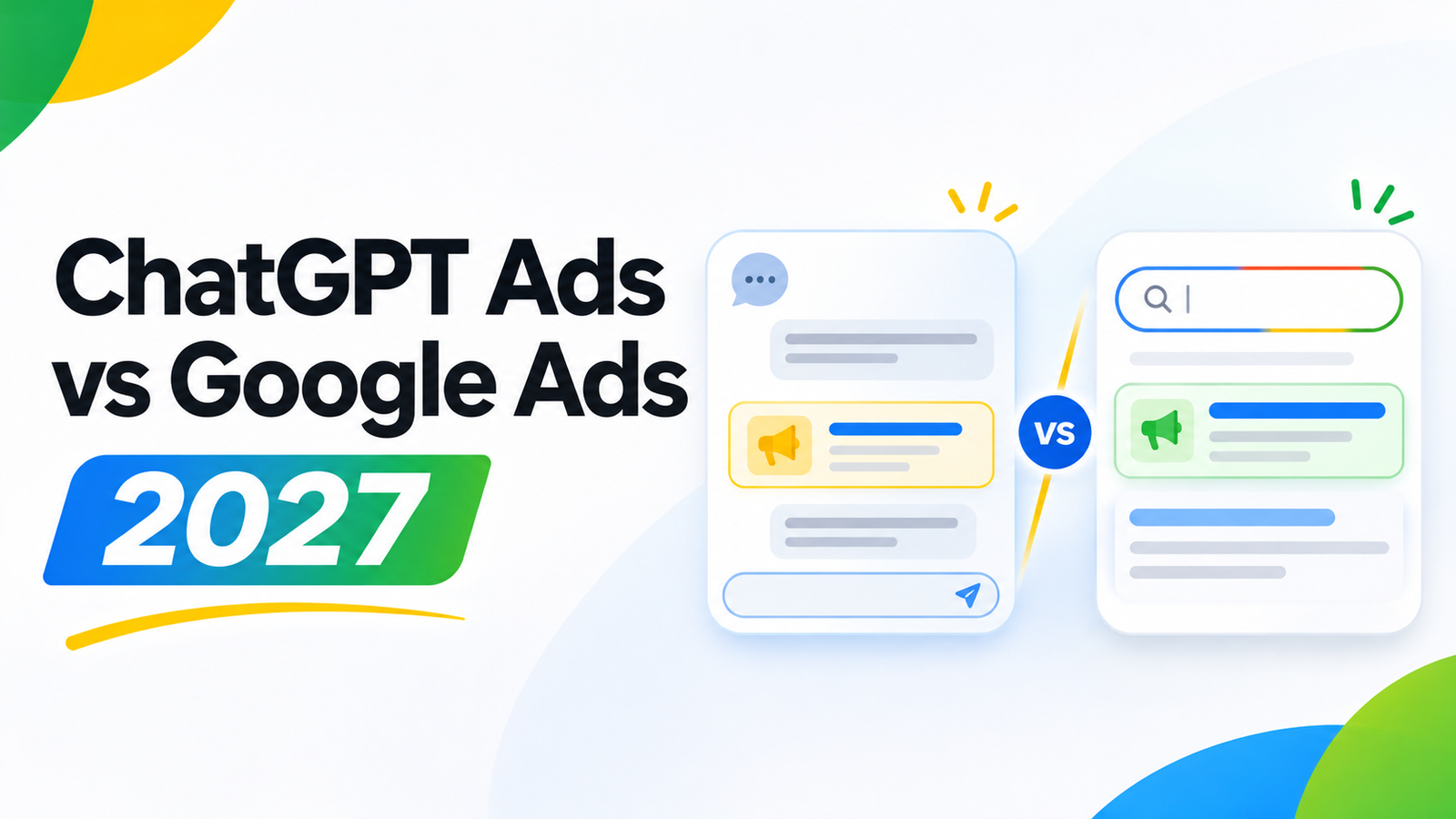
For nearly two decades, Google Ads has been one of the most important platforms for brands seeking customers with an identifiable purchase intent. From product searches and local services to ecommerce transactions, Google's advertising ecosystem connects businesses with consumers actively looking for information, products and solutions.
But artificial intelligence is changing where purchasing decisions begin.
A potential customer may now open ChatGPT to compare smartphones, shortlist accounting software, plan a holiday or evaluate business service providers—before entering a traditional search query.
This shift has created a new advertising opportunity.
In February 2026, OpenAI began testing advertisements in ChatGPT in the United States. By August, self-service advertising had expanded to India. By October 2026, OpenAI reported more than 100,000 advertisers had run campaigns across its increasingly international advertising platform.
Meanwhile, Google continues to operate a much larger advertising business. According to Alphabet's October 2026 financial results, Google Search and related advertising generated $63.35 billion in the July–September quarter alone.
That raises a critical question for marketers planning their 2027 budgets:
Should brands continue investing predominantly in Google Ads, redirect spending towards ChatGPT Ads, or use both platforms for different stages of customer acquisition?
The answer depends on audience behaviour, advertising economics, available targeting and the value of conversions—not simply which platform attracts more attention.
This guide compares ChatGPT Ads and Google Ads using official company disclosures, independent research, practical campaign examples and original budget models.
1. ChatGPT Ads vs Google Ads: The Fundamental Difference
The main distinction is how each platform interprets customer intent.
Google Search advertising traditionally begins when someone submits a search query. Keywords, campaign settings, bidding signals and Google's AI systems help determine which relevant advertisement may appear.
ChatGPT advertising works within a conversational environment.
A person may describe their requirements, discuss alternatives, refine preferences and explore a decision through several interactions.
ChatGPT's advertising system can assess the context of the conversation to identify potentially relevant sponsored messages.
An example from the Indian automobile market
Consider someone planning to purchase a new car.
On Google, they might search:
"Best SUV under ₹15 lakh in India."
A relevant Search advertisement could introduce a dealership, comparison platform or automotive brand.
In ChatGPT, the same person might ask:
"I drive 50 kilometres daily, need good rear-seat comfort, prefer an automatic SUV and have a budget of ₹15 lakh. Which factors should I compare?"
The conversation provides richer information about the person's requirements.
A sponsored automobile-related message could be relevant to that discussion, subject to available advertising inventory and eligibility.
However, ChatGPT Ads does not allow advertisers to pay to change ChatGPT's actual answer or recommendations.
Advertisements are separately labelled and displayed apart from the assistant's response.
This distinction is essential for understanding both the opportunity and the limitations of conversational advertising.
Sources: OpenAI's advertising principles and Google Search Ads documentation.
2. The Advertising Market in Numbers: What We Know Before 2027
Marketing predictions should begin with actual business data.
The following figures are based on the latest available official disclosures as of 14 November 2026.
| Industry indicator | Reported figure | Reference period |
|---|---|---|
| ChatGPT weekly active users | More than 1.2 billion | October 2026 |
| Advertisers that have used ChatGPT Ads | More than 100,000 | October 2026 |
| Countries with ChatGPT Ads availability | 89 | October 2026 |
| ChatGPT Ads annualized revenue run rate | $1 billion | August 2026 |
| Google Search & other advertising revenue | $63.35 billion | Q3 2026 |
| Total Google advertising revenue | $82.01 billion | Q3 2026 |
| Google Search & other revenue growth | Approximately 12% | Q3 2026 YoY |
Official sources: OpenAI's August 2026 announcement, OpenAI's October 2026 expansion and Alphabet's Q3 2026 SEC earnings release.
Understanding these numbers correctly
Three distinctions matter.
First, ChatGPT's 1.2 billion weekly active users are not equivalent to its advertising audience. Ads are primarily eligible on Free and Go plans, with additional age, regional and contextual restrictions.
Second, OpenAI's $1 billion annualized run rate is a point-in-time revenue pace. It is not the same as $1 billion in audited annual advertising revenue.
Third, Google's $63.35 billion represents a single quarter of Search and related revenue—not the same time period or reporting definition as OpenAI's annualized run rate.
Consequently, these numbers demonstrate differences in current business scale but should not be used to calculate an exact cross-platform advertising market share.
3. How ChatGPT Ads Works in 2026—and What That Means for 2027
OpenAI has moved beyond its initial advertising pilot.
Its current Ads Manager allows eligible advertisers to create campaigns, manage budgets, select available targeting options and measure outcomes.
Available advertising objectives
| Campaign objective | Buying and optimisation approach |
|---|---|
| Views | Impression-based buying using CPM |
| Clicks | Traffic-oriented campaigns using CPC |
| Conversions | Optimisation towards selected conversion events |
Conversion-optimised campaigns can use supported bidding arrangements, including click-based billing. A target CPA is an optimisation objective, not necessarily the event for which the advertiser is charged.
OpenAI also supports intelligent bidding and other automated strategies that evaluate expected campaign outcomes.
How ads are selected
OpenAI's advertising system considers relevance signals such as conversational context, advertisement content, landing pages and advertiser-provided context hints.
Where ads personalisation is available and enabled, additional permitted signals from a user's ChatGPT experience may be considered.
Context hints are not conventional exact-match keywords. Advertisers cannot guarantee that their sponsored message will appear in a particular conversation.
Advertising formats
ChatGPT Ads includes sponsored units with advertiser identity, headline, description, landing page and visual creative.
In October 2026, OpenAI introduced a multi-image format in Ads Manager as an open beta.
It has also announced experiments involving Sponsored Agents, which can allow users to choose to interact with a business-sponsored agent after clicking an advertisement.
Availability of experimental formats may vary.
Sources: OpenAI Ads Manager, campaign setup documentation and creative format guidance.
What to expect in 2027
It is reasonable to anticipate continued development of advertising formats, measurement and purchasing options because OpenAI has explicitly identified these as product priorities.
However, advertisers should not assume that unannounced formats, guaranteed inventory levels or specific 2027 targeting capabilities will become available on a particular date.
4. Google Ads in 2027: Why Search Still Matters
Google Ads offers significantly more than conventional text advertisements.
Its product ecosystem includes Search, Shopping, Performance Max, Demand Gen, Display, Video and App campaigns.
This allows advertisers to address different stages of the customer journey within one advertising platform.
Search Ads
Search campaigns target users expressing relevant search intent.
They remain especially useful when people know what they need and are actively looking for a product, supplier or service.
Shopping Ads
Product-focused advertisements can show images, prices, seller information and other attributes to users evaluating products.
Performance Max
Performance Max can optimise campaigns across eligible Google inventory, including Search, YouTube, Display, Discover, Gmail and Maps.
AI Max for Search
AI Max extends Search advertising with additional query matching, text customisation and landing-page selection capabilities.
This is an important development because Google is also using AI to interpret broader customer intent.
The comparison is therefore not simply between an AI-powered ChatGPT and a traditional keyword-only Google system.
Both platforms use artificial intelligence, but their interfaces, advertising inventory, targeting mechanisms and measurement ecosystems are different.
Sources: Google's advertising solutions, Google Search campaigns and Performance Max documentation.
5. ChatGPT Ads vs Google Ads: Complete Feature Comparison
| Feature | ChatGPT Ads | Google Ads |
|---|---|---|
| Core discovery environment | AI conversations | Search and multiple Google channels |
| Main intent signals | Conversational context and eligible targeting signals | Queries, keywords, audiences and campaign signals |
| CPC campaigns | Available | Available |
| CPM campaigns | Available | Available in supported campaign types |
| Conversion optimisation | Available | Available |
| Advertiser self-service | Available in supported markets | Established global platform |
| Creative formats | Sponsored image/text and developing interactive formats | Text, image, video, Shopping and other formats |
| Measurement | Ads Manager, Pixel, Conversions API, tracking parameters | Google Ads conversion tracking, integrations, imported conversions |
| Geographic control | Supported countries and eligible location options | Extensive location-targeting capabilities |
| Organic-answer influence | Paid ads do not influence ChatGPT responses | Paid ads are separate from organic ranking systems |
| Platform maturity | Newly established advertising ecosystem | Long-established advertising ecosystem |
The practical takeaway is that ChatGPT Ads offers an additional conversational advertising environment, while Google Ads currently provides a broader range of established campaign types and buying workflows.
6. ChatGPT Ads Cost vs Google Ads Cost in 2027
Advertising costs cannot be reduced to a universal price-per-click comparison.
Both platforms use bidding and auction mechanisms, with actual charges influenced by demand, relevance, competition and campaign configuration.
How much does ChatGPT advertising cost?
OpenAI's November 2026 advertiser documentation recommends that CPC advertisers may begin with a maximum bid of approximately $3–$5 per click.
This is bidding guidance, not a published global average CPC, compulsory minimum price or India-specific rate card.
Depending on the objective, advertisers can purchase valid clicks or eligible impressions and use supported conversion-focused bidding.
OpenAI has also introduced more advanced bidding controls.
Source: OpenAI — Ads in ChatGPT: The Basics.
How much does Google Ads cost?
Google does not offer a single fixed CPC applicable to all advertisers.
A search for a specialised enterprise software solution may have very different auction economics from a local restaurant promotion or inexpensive consumer product.
Advertisers can establish budgets and bidding strategies based on business objectives.
The actual price and performance depend on the market and competitive environment.
Why direct price comparisons can be misleading
Suppose ChatGPT Ads costs more per click than a particular Google campaign.
The higher CPC could still be worthwhile if it produces higher-value customers, larger orders or better qualified leads.
Conversely, a cheaper click is not valuable if it does not generate meaningful commercial outcomes.
For brands planning 2027 budgets, cost per incremental customer and contribution after advertising are more useful decision metrics than CPC alone.
7. What Independent Research Says About ChatGPT Ads vs Google Ads Performance
One of the most important developments in late 2026 was the publication of independent research directly comparing paid ChatGPT and Google Search traffic.
An October 2026 working paper by Maximilian Kaiser and Christian Schulze examined data from 1,898 ecommerce websites.
The broader dataset covered businesses with approximately $16 billion in annual sales.
The paid-advertising financial analysis used a substantially smaller subset, including 102 advertisers with complete revenue tracking.
Paid advertising performance in US ecommerce traffic
| Metric | ChatGPT Ads | Google Search Ads |
|---|---|---|
| Recorded revenue per paid visit | $0.89 | $2.45 |
| Purchase conversion rate | 0.37% | 1.17% |
| Revenue per 1,000 visits, calculated | $890 | $2,450 |
The researchers found approximately 64% lower revenue per recorded paid visit for ChatGPT Ads.
Among 87 advertisers purchasing both channels in the US comparison, 73 recorded no attributed ChatGPT-ad purchase during the observed period.
Source: Kaiser and Schulze, Can Advertising Fund Free AI?, October 2026.
Important limitations
The study was observational and, as of November 2026, remained a working paper under review.
Its paid-performance findings were based on a self-selected subset of ecommerce advertisers, not a random sample of all brands.
It also focused on recorded website outcomes, which may not capture every delayed purchase or broader brand effect.
These results should therefore not be interpreted as evidence that ChatGPT Ads will necessarily underperform Google Ads for B2B services, education, travel or every advertiser in 2027.
What about positive ChatGPT advertiser results?
OpenAI has reported advertiser and measurement-partner results showing stronger outcomes in some campaigns.
In October 2026, OpenAI cited a partner measurement of WeightWatchers reporting an attributed CPA 15.3% below its blended paid-search benchmark.
Earlier, OpenAI also referenced an ecommerce advertiser reporting 3x ROAS over a 28-day period.
These are selected examples rather than independent, representative industry benchmarks.
Source: OpenAI's October 2026 measurement update.
The emerging evidence is mixed: Early ecommerce research identifies significant conversion challenges, while certain advertisers report encouraging outcomes.
The right response is controlled experimentation rather than assuming either platform has universally superior ROI.
8. Where Should Brands Spend in 2027? Recommendations by Business Objective
The appropriate platform depends on what the customer is doing and how the brand defines a successful outcome.
| Brand objective | Initial priority to evaluate | Reason |
|---|---|---|
| Capture established high-intent searches | Google Search | Direct alignment with expressed search queries |
| Promote ecommerce product inventory | Google Shopping / Performance Max, plus ChatGPT tests | Established shopping distribution with an additional conversational discovery opportunity |
| Reach people comparing complex products | ChatGPT Ads alongside Google Search | Detailed consideration can occur through conversations and search |
| Generate local service enquiries | Google Search first where proven | Mature location-focused advertising and call/lead measurement |
| Promote B2B software | Both, with separately measured tests | Product research and vendor comparison occur through multiple journeys |
| Build awareness for a new product category | Relevant reach products on both platforms | Demand creation may matter more than immediate conversion |
| Maximise short-term profitable purchases | Channel with verified incremental contribution | Real business results outweigh platform preference |
These are strategic starting points, not evidence that one platform has a guaranteed advantage in every case.
Ecommerce brands
A D2C brand selling standardised products may initially rely more heavily on established Shopping and high-performing Search campaigns.
ChatGPT Ads can be tested for differentiated products that customers need help understanding or comparing.
B2B technology companies
Companies selling CRM, ERP or cybersecurity solutions may find conversational discovery relevant because customers often evaluate requirements before choosing a vendor.
However, long sales cycles require qualified-lead and pipeline measurement rather than simply counting clicks.
Education brands
Education providers can test campaigns built around programme selection, professional learning and course comparisons.
Both platforms should be evaluated on legitimate enquiries, enrolments and actual acquisition cost.
Local service businesses
Businesses focused on a narrow service area should verify whether their desired geographic targeting is supported on ChatGPT Ads before allocating significant budget.
Google's more established location-targeting options may remain operationally important.
9. The Market Creators 2027 Advertising Budget Framework
Instead of recommending one universal allocation, businesses can develop test budgets based on existing performance.
For illustration, consider an Indian brand with a ₹5,00,000 monthly paid-media budget.
| Planning approach | Google Ads | ChatGPT Ads |
|---|---|---|
| Conservative test: 90/10 | ₹4,50,000 | ₹50,000 |
| Balanced test: 80/20 | ₹4,00,000 | ₹1,00,000 |
| Larger experimental allocation: 60/40 | ₹3,00,000 | ₹2,00,000 |
These ratios are Market Creators' hypothetical scenarios, not reported industry spending patterns.
When a conservative test may be appropriate
A brand with consistently profitable Google campaigns but little evidence of ChatGPT performance may choose to preserve established demand-capture spending while testing the new platform.
When a larger ChatGPT test may be justified
A business may have more flexibility to experiment when it has strong margins, sufficient conversion volume, proven measurement, suitable ChatGPT audience eligibility and established campaigns approaching diminishing incremental returns.
When zero ChatGPT expenditure may be reasonable
A brand with limited budget, unreliable tracking, unsuitable geographic targeting or no ability to measure meaningful conversions may be better served by correcting those issues before introducing another paid channel.
The test allocation should be an explicit business decision, not an arbitrary requirement to advertise everywhere.
10. Original ROI Calculation: Which Platform Generates More Contribution?
A useful 2027 budget comparison should account for the amount of profit available from each additional conversion.
Consider a hypothetical Indian ecommerce brand.
Assume its average realised order value is ₹5,000 and its contribution margin before advertising is 35%.
The company allocates ₹5 lakh monthly, with 80% to Google Ads and 20% to ChatGPT Ads.
Illustrative financial model
| Metric | Google Ads | ChatGPT Ads |
|---|---|---|
| Advertising spend | ₹4,00,000 | ₹1,00,000 |
| Assumed average CPC | ₹40 | ₹50 |
| Estimated clicks | 10,000 | 2,000 |
| Assumed purchase conversion rate | 3.0% | 1.5% |
| Attributed purchases | 300 | 30 |
| Attributed sales | ₹15,00,000 | ₹1,50,000 |
| ROAS | 3.75x | 1.50x |
| Contribution before advertising | ₹5,25,000 | ₹52,500 |
| Contribution after advertising | +₹1,25,000 | −₹47,500 |
These are completely hypothetical inputs, not observed market CPC or conversion benchmarks.
The example illustrates why similar budgets and paid traffic can produce very different economic outcomes.
The maximum profitable CPC formula
Break-even CPC = Conversion Rate × Average Order Value × Pre-Ad Contribution Margin
For Google Ads:
3% × ₹5,000 × 35% = ₹52.50
For ChatGPT Ads:
1.5% × ₹5,000 × 35% = ₹26.25
Under the illustrative assumptions, Google Ads can tolerate a higher click cost because it generates more purchase value per click.
But if ChatGPT's actual conversion rate improves, average order value increases or acquisition costs decline, the conclusion can change.
This is why advertisers need their own conversion evidence.
The incremental-conversion problem
A further question is whether an attributed purchase would have happened without the advertisement.
If advertising merely redirects a customer who was already planning to buy, attributed ROAS may overstate incremental contribution.
A better allocation decision uses first-party transaction data, consistent attribution rules and controlled experiments where feasible.
11. How to Run ChatGPT Ads and Google Ads Together
An effective dual-platform strategy should not simply duplicate the same campaign and advertisement.
The two platforms serve different discovery environments.
Google Search campaign example
A software company could advertise against relevant searches such as:
"CRM software for small businesses"
Its landing page could include pricing, integrations, product demonstrations and a trial registration option.
ChatGPT campaign example
The same company could create advertisements addressing practical customer requirements:
"Managing leads in spreadsheets? Explore a CRM built for growing sales teams, with pipeline visibility and simple follow-up workflows."
This message speaks to a problem a user may be exploring through conversation.
It does not claim to be part of ChatGPT's independent recommendation.
Creative differences
Google Search creative should align with query intent, ad assets and the landing-page experience.
ChatGPT creative should provide clear, specific, benefit-focused information about what the advertiser offers and why it may be relevant.
OpenAI recommends testing distinct creative variations rather than repeating the same generic headline.
Source: OpenAI's creative guidance.
12. Measurement: The Most Important Challenge for 2027 Advertisers
Media allocation becomes unreliable when platforms report conversions using different definitions or attribution rules.
For Google Ads, advertisers can track purchases, enquiries, calls and imported business outcomes using available conversion measurement tools.
For ChatGPT Ads, OpenAI supports conversion measurement through the OpenAI Pixel and Conversions API.
Both platforms require proper setup and validation.
A cross-platform measurement dashboard
| Metric | Why it matters |
|---|---|
| Spend | Actual media expenditure |
| Clicks | Recorded website visits initiated by ads |
| CPC | Cost efficiency of paid traffic |
| Purchase or lead conversion rate | Efficiency of the landing-page journey |
| Cost per qualified lead | Value of enquiries beyond raw lead volume |
| ROAS | Recorded sales value relative to media expenditure |
| Contribution after advertising | Profitability after relevant variable costs |
| Incremental conversions | Additional outcomes associated with advertising |
| New-customer acquisition cost | Cost of acquiring customers who were not already buying |
Recommended tracking approach
Use consistent campaign naming and analytics parameters.
Configure platform conversion events and connect website or CRM outcomes where supported.
Deduplicate events where necessary.
Evaluate leads based on genuine qualification or revenue rather than counting every form submission as equally valuable.
Then review differences in attribution windows and definitions before comparing platform dashboards.
Google's conversion measurement guide and OpenAI's conversion measurement documentation provide the platform-specific foundations.
13. Privacy, Advertising Controls and Brand Safety
ChatGPT advertising raises questions because the platform is used for personal conversations.
OpenAI states that private conversations are not shared with advertisers and that user data is not sold to them.
Advertisements are selected using supported internal relevance signals, but advertisers do not receive access to users' chats, memory or private personal details.
OpenAI also states that ads do not influence the assistant's answers.
Advertising eligibility depends on factors including subscription plan, age and supported region.
Ads may appear to eligible Free and Go users; Plus, Pro and organisational paid tiers are excluded under the currently published arrangements.
What should advertisers check?
Brands should review each platform's advertising policies, privacy requirements, targeting permissions, creative standards and restricted content categories.
OpenAI offers brand-safety safeguards and certain additional exclusion capabilities for qualifying advertisers.
Google Ads provides its own policy, targeting, exclusion and brand-suitability controls across relevant campaign types.
For Indian businesses, sector-specific advertising obligations should also be reviewed, including the Advertising Standards Council of India's code.
Neither platform's automated ad review replaces an advertiser's legal or compliance responsibilities.
Source: OpenAI's advertising FAQ.
14. A 90-Day Advertising Experiment for 2027
Brands evaluating ChatGPT Ads for the first time can use a structured testing framework.
Days 1–30: Establish the baseline
Review existing Google Ads performance and identify products or services with dependable conversion measurement.
Confirm ChatGPT Ads account eligibility, supported geographies, campaign objectives and required tracking.
Develop platform-appropriate creatives and landing pages.
Days 31–60: Run a controlled test
Activate a defined ChatGPT test budget without unnecessarily disrupting established Google campaigns.
Measure delivery, paid visits, conversions, lead quality and contribution after media.
Use comparable periods and account for promotions, seasonal demand and concurrent marketing activity.
Days 61–90: Evaluate incremental value
Compare commercial outcomes rather than relying on clicks alone.
If the ChatGPT campaign generates promising conversion quality, expand the test cautiously.
If results are weak, identify whether the problem lies in audience fit, CPC, creative relevance, landing-page conversion or measurement.
Avoid declaring success from a small sample or abandoning the channel because of a handful of unsuccessful clicks.
The 90-day framework is an editorial planning recommendation, not a platform-defined learning period.
15. Seven Advertising Mistakes Brands Should Avoid in 2027
Assuming ChatGPT Ads automatically influences ChatGPT recommendations. Paid advertising and organic AI answers are separate.
Confusing total ChatGPT users with advertising reach. Not all users are eligible to see sponsored placements.
Comparing Google Ads CPC with an OpenAI maximum bid suggestion. A suggested maximum bid is not the same as actual average click cost.
Using the same creative for every platform. Search intent and conversational exploration are different contexts.
Measuring only attributed ROAS. Profitability depends on contribution margin, acquisition quality and incrementality.
Overreacting to early industry studies. Research conducted on a limited group of ecommerce advertisers cannot determine every industry's future performance.
Reducing profitable Google campaigns before testing the alternative. A new advertising channel should earn its budget through evidence rather than novelty.
16. What Could Change in 2027? Three Scenarios
Scenario A: Conversational advertising becomes more effective
If ChatGPT improves conversion optimisation, measurement and advertiser relevance, some brands may find greater value in expanding budgets.
Companies selling products that require substantial research or comparison could benefit from new opportunities during customer consideration.
Scenario B: Google strengthens its existing advantage
Google continues investing in AI-driven Search advertising, campaign automation, Shopping experiences and cross-channel measurement.
If these improvements maintain strong returns, advertisers may prefer to preserve existing allocations.
Scenario C: Both platforms develop complementary roles
A brand may use ChatGPT Ads to introduce relevant products during complex decision-making and Google Ads to reach customers searching for specific solutions or ready to transact.
This scenario would require advertisers to measure the combined customer journey rather than assuming either platform independently deserves credit for the final sale.
These are possibilities, not verified forecasts of market share, prices or future platform performance.
17. Frequently Asked Questions
Are ChatGPT Ads available in India?
Yes. OpenAI announced self-service ChatGPT advertising access in India on 31 August 2026, subject to advertiser eligibility and account requirements.
How much does ChatGPT advertising cost?
ChatGPT supports CPC, CPM and conversion-focused advertising options. OpenAI's late-2026 guidance references initial maximum CPC bids of approximately $3–$5, but this is not a guaranteed actual CPC or India-specific tariff.
Is ChatGPT Ads better than Google Ads?
Neither is universally better. Google provides a broader, established advertising ecosystem, while ChatGPT offers conversational ad opportunities. Actual conversion economics should determine the decision.
Can ChatGPT advertisers pay to be recommended in answers?
No. OpenAI states that advertisements do not influence ChatGPT's independent responses. Sponsored messages are separate from the assistant's answers.
Are ChatGPT Ads and Google AI Overviews the same?
No. ChatGPT Ads is OpenAI's paid advertising product. Google AI Overviews is a Google Search feature that generates AI summaries. The two operate within different products and systems.
Can small businesses use ChatGPT Ads?
OpenAI has introduced self-service Ads Manager access for eligible businesses, including smaller advertisers in supported markets. Available features and account restrictions can vary.
Should brands move 50% of their Google Ads budget to ChatGPT in 2027?
There is no reliable evidence supporting a universal 50% transfer. A business should evaluate its existing Google profitability, ChatGPT eligibility, conversion economics and the results of an appropriately sized test.
18. Final Verdict: Where Should Brands Invest Their Advertising Budgets in 2027?
Google Ads currently offers the more mature infrastructure for reaching customers across Search, Shopping, video and other established advertising environments.
ChatGPT Ads offers a different opportunity: reaching eligible users as they explore requirements, compare alternatives and work through decisions in a conversational setting.
Its rapid expansion in 2026 makes it a platform worth monitoring and, for suitable businesses, testing.
However, the independent ecommerce evidence available so far demonstrates why early enthusiasm must be balanced with measurement.
For brands with profitable Google campaigns, the most defensible starting point for 2027 is to protect proven incremental returns while testing ChatGPT Ads with a controlled budget.
Businesses should expand ChatGPT investment when their own data shows that the channel contributes meaningful additional business value.
A brand selling complex, high-consideration products may reach a different conclusion from one selling low-margin commodity goods.
The most successful 2027 advertising strategy will not be determined by whether a brand chooses Google or ChatGPT.
It will depend on how effectively the brand combines customer intent, creative relevance, accurate measurement and profitable media investment.
Plan a Future-Ready Advertising Strategy with Market Creators
As consumer discovery evolves, brands need media strategies that connect search, digital engagement and emerging AI advertising environments.
Market Creators helps businesses evaluate advertising objectives, select appropriate channels, develop relevant creative messages and build measurement-focused campaigns.
Explore our Performance Marketing services, Media Planning & Buying, and SEO, AEO & GEO services.
To discuss an advertising budget or future campaign strategy, contact Market Creators.